Showing posts with label Rao Yi (饶毅). Show all posts

Wednesday, August 17, 2011

Rao Yi Out of Academician Race, Protests Openly

Rao Yi, professor of biology and the dean of College of Life Science at Peking University, lost out in the first round of the selection process for a new class of members of the Chinese Academy of Science.

The outcome was both shocking and expected. While an excellent research scientist in his own field, Rao Yi has also been very outspoken in his criticism of the current academic system in China.

In an unusual response, Professor Rao Yi wrote a post in his blog expressing gratitude to the scholars who nominated him but declared that he would never be a candidate for CAS again. The news and his protest is carried in at least some of the official newspapers in China.

Monday, September 27, 2010

Xiao Chuanguo vs. Fang Zhouzi: A Chronology

Professor Xiao Chuanguo first surfaced in the world internet forums some time near the turn of the centry. But nobody knew him then -- He was posting under a pseudonym "Confused Professor" (昏教授). Around the same time, Fang Zhouzi was starting his efforts in exposing scientific fraud in China. "Confused Professor" took an interest in Fang Zhouzi's actions and decided that he didn't like what he saw. He posted a few articles criticizing Fang Zhouzi.

In 2001, Fang Zhouzi published a popular science essay in a newspaper in China, introducing some recent research results to the general public. "Confused Professor" reported it to Science, which carried the original study, as a case of plagiarism. Science responded that it was not plagiarism because Fang Zhouzi "neither implied that the work was his own by writing in the first person nor directly copied the language in the Science paper." Nevertheless, "Confused Professor" and his followers continued to propagate the myth that Fang Zhouzi had committed plagiarism.

Fast forward to the fall of 2005, "Confused Professor" was revealed to be Professor Xiao Chuanguo, then in the process of moving back to China from his post in New York and applying to become a member of the prestigeous Chinese Academy of Science. Alerted netters wrote to New Threads suggesting that Xiao Chuanguo had been mispresenting his resume in his application. On September 21, 2005, Fang Zhouzi publised an essay in Beijing Science and Technology summarizing the charges, questioning Xiao Chuanguo's claims of his academic status, number of publications and that he had invented a world-famous "Xiao's Procedure" (At that time, the term "Xiao's Procedure" had only existed in Xiao Chuanguo's own tellings).

In October, Xiao Chuanguo sued Fang Zhouzi and the newspapers that carried the articles.

May, 2006, as Fang Zhouzi's efforts were exposing more scientific fraud in China, 120 Chinese scholars, mostly biologists based in US, published an open letter calling for a stop of such public investigation in the name of protecting scientists' reputations.

That June, Xiao Chuanguo also published an open letter of his own, attacking Fang Zhouzi personally and swore that "this must be revenged!" He followed that up by launching a series of libel suits against Fang Zhouzi.

On July 31, 2006, a local court in Wuhan reached verdict on the very first Xiao Chuanguo vs. Fang Zhouzi case. The court decided in favor of Xiao Chuanguo, employing some very convoluted logic. Fang Zhouzi denounced it as a practice of local protectionism and vowed to defy any penalty ruling.

That very same day, an open letter supporting Fang Zhouzi began circulating. Over a hundred people signed up right away. The number of signatures eventually reached over 600.

September 5, 2006, Xiao Chuanguo launched another lawsuit against Fang Zhouzi, this time in Beijing, challenging Fang Zhouzi's assertion of local protectionism in Wuhan, where Xiao Chuanguo lived and worked. Also in that September, Rao Yi, then a professor at Northwestern University in US, published a friend-of-court style essay criticizing Xiao Chuanguo. In China, Professor Qing Chenrui (the wife of Professor He Zuoxiu) also published an open letter supporting Fang Zhouzi.

By November that year, escalation continued. Xiao Chuanguo launched another round of lawsuits, this time in New York against Rao Yi, Fang Zhouzi, and New Threads. (Rao Yi's insurance company in US eventually settled on his behalf.)

In China, Professor He Zuoxiu and Fang Zhouzi's lawyer Peng Jian established a Fund in support Fang Zhouzi, who at that time was also facing several other lawsuits in addition to those by Xiao Chuanguo. Overseas, The Organization of Scientific and Academic Integrity in China was also formed to collect donations supporting Fang Zhouzi's cause. Science reported thusly, "China's Fraud Buster Hit by Libel Judgements; Defenders Rally Round"

March, 2007, Xiao Chuanguo, together with other plaintiffs against Fang Zhouzi, issued a public threat to all signatories of the open letter supporing Fang Zhouzi, vowing to sue every person who did not publicly rennounce their signatures. Within that month, Fang Zhouzi lost most of those cases in several courts. He once again pledged to defy the judgements.

But then on May 28, 2007, Beijing Intermediate Court reached a verdict in Fang Zhouzi's favor, a first court victory of its kind.

After that, the dispute seems to have died down for a couple of years until August 2009 when Xiao Chuanguo boasted on Internet that he had received a court-issued fine from Fang Zhouzi. It was news to the latter. It was then that Fang Zhouzi discovered that his wife's bank account had been raided by the Wuhan court without their knowledge. (Fang Zhouzi and his wife had a prenuptial agreement that separates their finances.) His appeal was denied by the court.

In the months of October through December of 2009, a couple of Chinese newspapers, led by science reporter Fang Xuanchang, published a series of investigative findings exposing the ineffectiveness of the Xiao's Procedure and its severe side effects. Lawyer Peng Jian announced lawsuits to seek damages from the surgery.

February, 2010, A group of volunteers of New Threads collected documented materials and published an open letter questioning the Xiao's Procedure. The letter was sent to several institions and hospitals involved in clinical trials of the procedure in US.

August, 2010, the first clinial trial result of Xiao's Procedure from Beaumont Hospital in Michigan, US, was published in Journal of Urology. The journal also published sharply critical comments.

June 24, 2010, reporter Fang Xuanchang was brutally attacked by two thugs on his way home. He suffered serious head injuries and barely escaped.

August 29, 2010, Fang Zhouzi was attacked in daylight in a similar mannar. Fortunately he was able to escape with only minor injuries.

September 20, 2010, Xiao Chuanguo was arrested and identified as the mastermind behind both attacks.


Monday, April 12, 2010

AP: Rampant Cheating Hurts China's Research Ambitions

The following is a story from Associated Press published on April 11. It cited Fang Zhouzi and New Threads as well as Professor Rao Yi:

Rampant Cheating Hurts China's Research Ambitions

By Gillian Wong

LIUZHOU, China – When professors in China need to author research papers to get promoted, many turn to people like Lu Keqian.

Working on his laptop in a cramped spare bedroom, the former schoolteacher ghostwrites for professors, students, government offices — anyone willing to pay his fee, typically about 300 yuan ($45).

"My opinion is that writing papers for someone else is not wrong," he said. "There will always be a time when one needs help from others. Even our great leaders Mao Zedong and Deng Xiaoping needed help writing."

Ghostwriting, plagiarizing or faking results is so rampant in Chinese academia that some experts worry it could hinder China's efforts to become a leader in science.

The communist government views science as critical to China's modernization, and the latest calls for government spending on science and technology to grow by 8 percent to 163 billion yuan ($24 billion) this year.

State-run media recently exulted over reports that China publishes more papers in international journals than any except the U.S. But not all the research stands up to scrutiny. In December, a British journal retracted 70 papers from a Chinese university, all by the same two lead scientists, saying the work had been fabricated.

"Academic fraud, misconduct and ethical violations are very common in China," said professor Rao Yi, dean of the life sciences school at Peking University in the capital. "It is a big problem."
Critics blame weak penalties and a system that bases faculty promotions and bonuses on number, rather than quality, of papers published.

Dan Ben-Canaan is familiar with plagiarism.

The Israeli professor has been teaching for nine years at Heilongjiang University in the northeastern city of Harbin. A colleague approached him in 2008 for a paper he wrote about the kidnapping and murder of a Jewish musician in Harbin in 1933 during the Japanese occupation.
"He had the audacity to present it as his own paper at a conference that I organized," Ben-Canaan said. "Without any shame!"

In a separate case, he gave material he had written to a researcher at the prestigious Chinese Academy of Social Sciences. He said he was shocked to receive a book by the academic that was mostly a copy and translation of the material Ben-Canaan had provided — without any attribution.

The pressure to publish has created a ghostwriting boom. Nearly 1 billion yuan (more than $145 million) was spent on academic papers in China last year, up fivefold from 2007, a study by Wuhan University professor Shen Yang showed.

One company providing such a service is Lu's, in Liuzhou, a southern industrial city. His Lu Ke Academic Center boasts a network of 20 to 30 graduate students and professors whose specialties range from computer technology to military affairs.

Lu, a 58-year-old Communist Party member, is approached by clients through Internet chat programs. Most are college professors seeking promotions and students seeking help on theses. Once, 10 students from the same college class put in a collective request for him to write their papers, he said.

"Doing everything on your own, independently, should be possible in theory, but in reality it is quite difficult and one will always need some help," Lu said. "This is how I see it. I don't know if it is right."

Even in the business of selling research papers, there are cheats. Among the papers bought and sold in 2007, more than 70 percent were plagiarized, the Wuhan study found.

Early last year, Internet users found that the deputy principal of Anhui Agricultural University had committed plagiarism in as many as 20 papers. The university removed him from his post but allowed him to continue teaching.

In June, the principal of a traditional Chinese medicine university in the city of Guangzhou was accused of plagiarizing at least 40 percent of his doctoral thesis from another paper.

And in March, the state-run China Youth Daily reported a 1997 medical paper had been plagiarized repeatedly over the past decade. At least 25 people from 16 organizations copied from the work, and more doctors are expected to be named as the investigation by two students using plagiarism-detecting software continues, the report said.

Fang Shimin, an independent investigator of fraud, said he and his volunteers expose about a hundred cases every year, publicizing them on a Web site titled "New Threads."

"The most common ones are plagiarism and exaggerating academic achievement," Fang said.
The papers retracted by the British journal came from researchers at Jinggangshan University in southeastern China. The editors are checking other papers from the same institution, and say more retractions are expected. Calls and e-mails sent to Zhong Hua and Liu Tao, the two researchers named as lead authors of the papers, were unanswered. Other researchers contacted at the university too did not respond.

The journal, Acta Crystallographica Section E, publishes discoveries of new crystal structures, much of it from legitimate Chinese research.

"Chinese authors have submitted thousands of high quality structures to Acta E, which represent an important contribution to science," wrote Peter Strickland, managing editor of Journals of the International Union of Crystallography, which owns Acta E, in an e-mail. He said it was the first time fraudulent papers had been found in any of the journals.

Richard P. Suttmeier, an expert in Chinese science policy at the University of Oregon, said the problems can be traced to China's efforts to modernize its science system in the 1980s and early 1990s when research accountability and evaluation were still weak.

In trying to find ready measures of achievement, China emulated Western practices and began to focus on high-quality publications, but with mixed results, he said.

The problems could hurt the country's ambition of becoming a global leader in research, Suttmeier said.

"I suspect there will be less appetite for non-Chinese scientists to collaborate with Chinese colleagues who are operating in a culture of misconduct," he said.

Last month the Education Ministry released guidelines for forming a 35-member watchdog committee. Also, in a faxed reply to questions, it said it has asked universities to get tough.
Rao, the Peking University dean, remains skeptical.

Government ministries are happy to fund research but not to police it, he said. "The authorities don't want to be the bad guy."
___
Associated Press researcher Xi Yue contributed to this report.

Sunday, January 31, 2010

South China Morning Post: The Lie Detector

South China Morning Post is a leading English language newspaper in Hong Kong. In its January 31, 2010 edition, it publishes a lengthy article on Fang Zhouzi's struggle against scientific misconduct in China.

Below is the report, provided by Fang Zhouzi on New Threads:

The Lie Detector

Widespread corruption among some of the mainland's most ambitious academics has undermined the country's scientific community but one man has made it his mission to expose the culprits and clean up the system

Paul Mooney

Jan 31, 2010, South China Morning Post Magazine

On January 16, Fang Shimin kicked off the new year with a recap of his top 10 news items of 2009. On his popular New Threads blog, Fang, both respected and hated as the mainland's self-appointed "science cop", revisited a string of startling allegations: 12 university presidents and vice-presidents accused of plagiarism; a university president who claimed a leading scientific prize that was not rightfully his; two professors caught faking research results in an international journal; and a medical doctor who distorted the success rate for a new surgical procedure, which could have had serious health implications.

Fang's rogue's gallery made it seem like every time a light bulb goes on in the head of a genuine genius, there's a mainland scientist at hand to steal the idea and bask in the illicit glory, but the list came as no surprise to followers of the blog. For close to a decade, Fang, who goes by the pen name Fang Zhouzi, has been using the site to battle academic corruption, which, some say, has become so endemic on the mainland, it poses a threat to the country's development.

Fang, who earned a PhD in biochemistry from Michigan State University, in the United States, in 1995, became concerned about the phenomenon in 2000, when he started to see an increase in reports of academic cheating on the internet and in the print media. A fan of literature, Fang had a literary website called New Threads, which he has since employed to expose academic fraud.

"I care about science in China," he says, sitting in a Beijing cafe. "I want to see it go somewhere. [academic fraud] is more common [here] than in any other country and more common than in any other period in Chinese history."

A survey conducted by the China Association for Science and Technology showed more than half of the scientists contacted said they were personally familiar with cases of scientific misconduct. However, few of the guilty parties are punished and that's what irks Fang, whose training in the US exposed him to a system in which plagiarism is rare and, when it does occur, is severely punished.

Shen Yang, an associate professor at the Information Management School of Wuhan University, pioneered software that detects plagiarism in university papers, but the will to implement such innovation has yet to surface.

Fang says that out of the more than 900 cases of academic corruption he has exposed only 20 have resulted in punishment - and the majority of those involved students.

New Threads receives about 100,000 hits a week, with close to 16 million people - academics and students primarily but also journalists - having visited it during the past nine years. The government occasionally blocks access, forcing users to reach it via mirror sites.

"New Threads is the news source for the vast majority of science journalists in China, including myself," says Fang Xuanchang (no relation to Fang Shimin), a reporter with Science News.
"Actually, the vast majority of the cases of academic corruption that were brought to light by the media in recent years were originally exposed by contributors to the New Threads blog," says the journalist, who calls the site the "New Threads deep throat", in reference to the informant in the US' Watergate scandal.

Fang Shimin says he gets more than 20 e-mails a day reporting academic corruption and he spends an average of four hours following up on the claims. He says he applies strict criteria in handling reports: accusers must provide their name - many decline to do this out of fear of retribution; concrete evidence must be provided; and the case must be relevant. Fang often does his own research, sometimes consulting with experts in fields he is less familiar with.

Academic corruption runs the gamut from false claims about international awards to outright intellectual-property theft. No less than 16 Chinese scholars have claimed to have won the prestigious Albert Einstein World Award of Science since it was launched in 1984. For some years, more than one mainland scientist has claimed the award, despite that fact that it is given to only to one person a year. A search of the recipients list on the website of the World Cultural Council - the body that bestows the honour - yields not one Chinese name.

In 2006, when Fang, acting on a tip, pored over the online resume of the new assistant dean of Tsinghua University's medical school, he became suspicious when he noticed that one of the research papers it listed was about the molecular biology of HIV - a subject not related to the dean's speciality: surgery. Fang dug a bit further and discovered that the paper had been written by a Chinese scientist in the US with the same family name and first initial. He also discovered the professor had lied about his work experience.

Fang argued that Xiao Chuanguo, professor of urology at Huazhong University of Science and Technology, had lied about winning a major award given by the American Urological Association and questioned the success rate of a new surgical procedure being touted by Xiao. The doctor failed in two attempts to be appointed to the prestigious Chinese Academy of Sciences (CAS) and scholars credit New Threads for this.

Fang says that prior to the 1990s, the government had tight control on science and research and managed to keep a lid on cheating.

"After reform and opening, the controls were relaxed, and that was a good thing," he says. "We don't want the government controlling everything. But the side effect was that corruption and misconduct emerged."

Critics say government efforts to modernise the higher-education system are exacerbating the problem. The Ministry of Education and universities put pressure on academics to publish in journals catalogued by the Science Citation Index. School rankings, funding and monetary rewards are often based on such results.

A PhD candidate has to publish at least three papers before he can graduate, says Fang, and many graduate students are also required to publish. "That's huge, particularly for someone in biology or medicine," says Fang.

The publish-or-perish phenomenon has even extended to people teaching at junior colleges and high schools. But as more papers need to be published than can be accommodated by the country's key journals - the numbers run close to 500,000 per year - the trend has spawned a raft of low-quality "black journals", in which people pay to have their papers published.

"It's become a huge industry," says Fang. "And no one trusts the papers published in this kind of journal. It's just for promotion."

The pressure to publish has meant scholars churn out papers, often paying little attention to the quality of research or even lifting information from other sources without giving attribution. In many cases, professors allow their graduate students to do their research. If the student plagiarises, the professor pleads ignorance.

One of the problems, as Fang sees it, is that the fear of being caught is no disincentive.
"No one cares because the majority of scientists are involved in misconduct," he says. "So they don't think it's a big deal. You don't need to worry about being caught or punished."
Officials bear some of the blame, too, says Fang.

"The officials who have the power to distribute funding for research know nothing about science," he says. "They only know how to count the number of academic papers one has published. You only have to copy other peoples' papers and they say, `You've done a good job, here's your funding.'"

Universities and the government are often reluctant to punish cheaters, especially high-level scientists or someone who has Communist Party connections, which means just about any senior academic official.

"Government officials don't want to investigate and punish a vice-president or a president of a university because there's nothing in it for them," says Fang.

Universities will usually try to cover up such behaviour to protect the reputation of the institution. CAS members bring in large amounts of funding for their universities, Fang says. His website has exposed the misdeeds of about 20 members of the academy but none has been officially investigated or punished, he says.

He Shigang, of the CAS' Institute of Biophysics and a supporter of Fang, says: "Everything boils down to the political system. If the political system is corrupted you can't have a clean environment for anything."

"[although the number is rising slightly] what appears in the media is a very small minority of the cases," says Fang Xuanchang. "Journalists have to consider whether or not there's a risk in reporting something. As a result, many cases go unreported."

There's a long history of scholarly cheating in China. During the Qing dynasty (1644-1911), scholars taking the rigorous imperial exam, to win coveted positions in the civil service, resorted to all sorts of tricks, including smuggling in miniature books, cheat sheets the size of a fingernail and even undershirts covered with relevant information.

In 1964, Mao Zedong went so far as to endorse cheating during a speech in which he criticised the staid education system and its emphasis on exams.

"At examinations, whispering into each other's ears and taking other people's places ought to be allowed," he declared. "If your answer is good and I copy it, then mine should be counted as good."

Cheating is also rampant among students. In recent years, qiangshou, or "hired guns", have been employed to take exams. Their services can be retained for just about any test on the mainland, including English language exams. One now-defunct website offered three options: a hired gun for 2,000 yuan (HK$2,275), answers in advance for 4,000 yuan or, for 1,200 yuan, answers provided during the test via a wireless device described as an imported "satellite receiver" no bigger than a thumbnail.

Fang says he makes no money from his blog, relying instead on the popular science books he writes to earn a living.

Eleven lawsuits have been brought against the crusader: courts ruled against him in three cases and dismissed five, while three are pending.

Xiao sued Fang for libel in a local court in Wuhan, Hubei province, where he teaches, winning the case and an appeal. Fang ignored the ruling and, last year, the court deducted 40,763 yuan from his wife's bank account.

Some of the legal cases have bordered on the absurd. In November 2006, the family of scholar Liu Zihua sued Fang for libel. In the 30s, Liu argued that he had used the Eight Diagrams theory - from ancient Chinese philosophy - to discover a 10th planet in the solar system, a claim Fang labelled "pseudoscience". The No 2 Beijing Intermediary Court ruled against Fang, fining him 20,000 yuan - despite the fact that Liu had passed away 14 years earlier.

Fang's legal setbacks are the result of politics, local cronyism and a flawed legal system, claims He. "I think he does his homework very carefully. That's the reason I respect him so much."
Supporters have set up a legal defence fund to defray his court costs as well as another website to fight his detractors.

Meanwhile, there is growing concern that academic cheating could adversely affect the development of education and science on the mainland. Fang says international academic journals are now reluctant to accept submissions from Chinese scholars, a problem that was highlighted last month when scientific journal Acta Crystallographica Sections E published an editorial announcing that some 70 crystal structures submitted by two scientists from Jinggangshan University, in Jiangxi, in 2007, had been faked.

Cao Cong, a senior research associate with the Neil D Levin Graduate Institute of International Relations and Commerce at the State University of New York, wrote this month that the peer-reviewed journal had been flooded with Chinese papers, ostensibly because it's just a database of crystal structures in which articles are usually one page long and go through a less-than-vigorous review process. Cao wrote that one chemistry professor at Heilongjiang University had submitted 297 papers to Acta Crystallographica over the past five years.

The incident attracted the attention of Richard Horton, editor-in-chief of medical journal The Lancet, who wrote that rewarding Chinese scholars for being prolific publishers was creating problems.

"In China, unfortunately, there are great incentives to commit fraud," he wrote on The Lancet's website. "When you make prestigious jobs and large amounts of money closely tied to publication, that creates conditions for fraud.

"The concern is if science in China cannot be trusted in certain areas, that undermines China's economic growth."

"Academic corruption is an incredible waste of taxpayer money," says Fang Xuanchang. "Furthermore, this general trend of corruption in scholarly circles will lead to a decline in the efficacy of scientific research and seriously obstruct China's dream of internationalising."

While on the surface it appears New Threads has had limited success, "without Fang Shimin, academic corruption in China would have been worse", says Rao Yi, dean of the School of Life Sciences at Peking University.

"Fang's goal of fighting academic misconduct should not be simply reduced to the number of people who are punished," says Fang Xuanchang. "The more important thing is making those potential cheaters afraid, which has resulted in reducing the emergence of this phenomenon within the academic world."

Fang Shimin says the Ministry of Education and the Ministry of Science and Technology (MoST) have both laid down guidelines for dealing with academic misconduct but he doubts they will be enforced. MoST set up the Office of Scientific Research Integrity in 2007, he says, but he's not heard of the office investigating a single case. He also contends that some MoST officials are corrupt and accept kickbacks for handing out research funding.

"There's an office at least," he says, optimistically. "The government now recognises that it's a problem - and although it hasn't done anything, I think that's progress."

Thursday, January 7, 2010

Shi Yigong and Rao Yi Headline NYT Article

The New York Times published an article today titled as "Fighting Trend, China Is Luring Scientists Home". It headlines the two prominent returnees, biologists Shi Yigong and Rao Yi, as examples how Chinese-born star scientists are now being lured back to their homeland.

What is surprising and interesting, though, is its mention of Rao Yi renouncing his American citizenship:
Rao Yi, a 47-year-old biologist who left Northwestern University in 2007 to become dean of the School of Life Sciences at Peking University in Beijing, contrasts China’s “soul-searching” with America’s self-satisfaction. When the United States Embassy in Beijing asked him to explain why he wanted to renounce his American citizenship, he wrote that the United States had lost its moral leadership after the 9/11 attacks. But “the American people are still reveling in the greatness of the country and themselves,” he said in a draft letter.
There was no words about Shi Yigong, who had been criticized in China for preaching/teaching patriotism to Chinese students while holding an American passport himself.

Tuesday, August 11, 2009

Local Chinese Court Steals Money from Fang Zhouzi's Wife

One of the most significant fraud case exposed by Fang Zhouzi was that involving Professor Xiao Chuanguo, a self-claimed world-famous urologist. The case first came to light in September, 2005, when Xiao Chuanguo was being nominated to become an Academician. Fang Zhouzi publicly accused Xiao Chuanguo for having engaged in various acts of exageration in his credentials.

Xiao Chuanguo's Academician candidacy was then denied by Chinese Academy of Science. Xiao Chuanguo blamed his lose entirely on Fang Zhouzi's words and sued the later in local courts in Wuhan, Beijing, as well as New York.

He won his case in Wuhan, whose court issued a few ridiculous justification for its verdict that had become running jokes on the Internet, such as the definition of "international journal," the validity of Xiao Chuanguo's award claim, and a procedure supposed to be named after him. The case gained its dramatic status after Xiao Chuanguo published a foul-mouthed open letter of his own and hundreds of Chinese scholars co-signed an open letter to support Fang Zhouzi.

After losing his appeal, Fang Zhouzi has refused to obey the court order of apologizing to Xiao Chuanguo and paying a fine. The case seemed to have disappeared from public view, especially after many officials of that local court, including the judge in the case, were later disciplined for corruption charges. Fang Zhouzi had assumed that the case was forgotten.

Until now.

Messages posted by Xiao Chuanguo's well known pseudo-name showed up in online forums lately, boasting that he had received monetary judgement from Fang Zhouzi. It was not until Fang Zhouzi was alerted of the messages when he discovered that a sum of more than 40,000 Yuan (5,840 USD) has disappeared from his wife's private bank account. Upon inquiry, the bank confirmed that they transferred the money at the order of the Wuhan local court.

The unusual and stealth way that the court has taken the money both surprised and angered Fang Zhouzi, as well as many of his supporters on New Threads. Fang Zhouzi vowed to fight for this unlawful case. He explained that he and his wife have maintained independent financial records and his wife is never involved in his efforts of exposing frauds that led to his various court troubles.

Tuesday, August 4, 2009

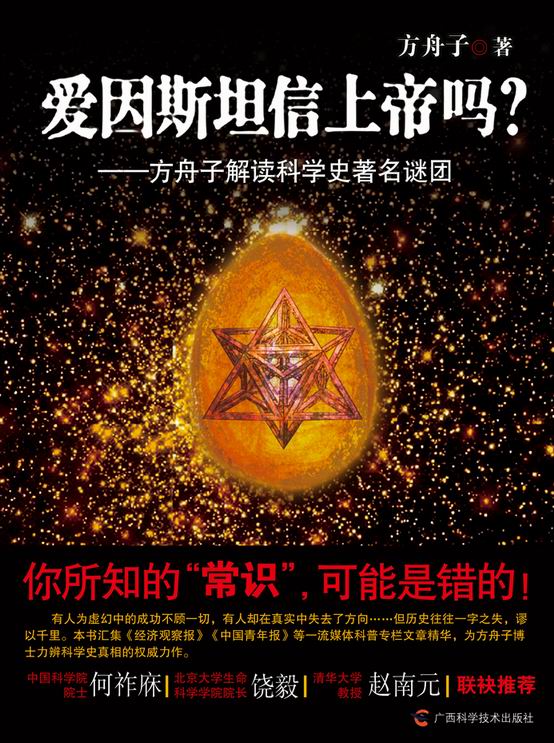
Did Einstein Believe in God?


That's the title of Fang Zhouzi's new book which just became available in China. The book has a subtitle "Fang Zhouzi Explains Famous Puzzling Cases in the History of Science" and is a collection of many essays and columns by the author previously published in newspapers and web sites.

In the Preface titled as "Scientists are humans too," the author made it clear that the book is about many controversies surrounding famous scientists and their discoveries of the past, some of which involved issues of personal integrity.

The book comes with high praise and recommendation by several famous Chinese scientists including Rao Yi.

Saturday, May 9, 2009

Rao Yi Reports on a Fraud Case

In his online blog, Rao Yi reported a recent case of scientific fraud in a Shanghai institute of the Chinese Academy of Science.

About a month ago, the Journal of Neuroscience informed the institute that a paper authored by a researcher of the institute contained practices of scientific fraud. After investigating for a month, the institute informed the Journal of their findings. It decided to fire the researcher and close the laboratory within a year.

Rao Yi praised for the swift and strict disciplinary action. However, he did not mention the name of the accused or disclose any details of the case.

Sunday, February 8, 2009

Talking about Shi Yigong's Salary

There is a usual routine in Chinese media in praising patriotic scholars returning from abroad to serve the motherland. Inevitably, they are described as giving up privileged academic positions, luxury houses, and fancy cars for a presumably much lesser environment in China. The description might have had some truth in it in the past couple of decades but it has gradually lost its base as China is more and more willing to spend big money luring oversea talents.

The most recent media star Professor Shi Yigong is being described in the same manner. Before returning to China, Shi Yigong was the Warner-Lambert/Parke-Davis Professor of molecular biology at Princeton University. So it is true that he had given up a lot in returning. He was made a professor and associated dean at Tsinghua University, one of the most privileged school in China. As the media campaign on his sacrifice continued, his salary at Tsinghua University became the talk of town.

A professor at the same college as Shi Yigong at Tshinghua University disclosed that Shi Yigong's salary is about 1.7 million RMB, which is roughly more than 200,000 in USD. If this figure is true, his salary will be at least compatible with what he earned at Princeton and more than ten times of other professors in the same Chinese school. So much for the sacrifice.

The issue received world-wide attention. A news report by Nature initially quoted the 1.7 million figure in describing how China is attracting top talents. The story drew a firestorm in its online comments and the magazine was forced to apologize and revise its content to exclude the exact figure.

Shi Yigong's colleague at Peking University, Professor Rao Yi, claimed that his salary is actually less than one million in RMB. Shi Yigong and Tsinghua University chose to remain silent. Fang Zhouzi is advocating for an open policy regarding salaries in public schools. He used examples of public schools in America disclosing professor salaries to illustrate that concerns of privacy do not apply in such a situation. Tsinghua University, like pretty much every other school in China, is a public and national institute.

Lately, Fang Zhouzi had been invited to present his case in a radio talk show.

Wednesday, January 14, 2009

Rao Yi Speaks Out on Shi Yigong's Grant Application

While the official media kept silent on the controversy of Shi Yigong's grant application yet hailing him as the new patriotic hero, Professor Rao Yi offered his personal views on the controversy. In fact, Rao Yi blamed the deafening silence of the grant authority as being unfair to Shi Yigong.

Rao Yi asserts that only the grant authority has the right to interpret its own rules and its applicability to Shi Yigong's application. From his own personal contacts, he learned that the committee in charge of the grants had conducted a thorough investigation after Fang Zhouzi's accusation. Both Shi Yigong and his Tsinghua University had been truthful and forthcoming on his job status throughout the investigation. The committee took votes on the issue and concluded that Shi Yigong was qualified for the grant even when his case apparently violated the rule on the letters.

The committee appeared to think that there is no need to offer any explanation for its decision either to the accuser or the public. Rao Yi disagreed. He felt the need to publish what he knew so that Shi Yigong would not be unfairly blamed for knowingly violating a rule.

Wednesday, August 20, 2008

Did Professor Shi Yigong Step Over the Line?

Professor Shi Yigong, who recently gave up a prestige position at Princeton to return to Tsinghua University, had been making a name for himself in China. Unlike the fellow returnee Professor Rao Yi, Shi Yigong tended to boast a higher personal profile. In an interview on Science Times, he claimed that his return was motivated by a strong patriotic brief. He expressed the desire to teach a new course on patriotism in Tsinghua.

Yet Professor Shi Yigong had already become an American citizen while he was in the United States. It might be quite awkward for him to teach such a course in China.

What's more, his status in Princeton was far from clear. It did not appear that he had simply given up his post as he had claimed. The Princeton University web site listed him simply as "on leave until September 2009", which means that he still maintains a position there.

There was no question that Professor Shi is working full time at Tshinghua right now. But his status at Princeton University brought up a questionable issue in his receiving a research grant from the Chinese National Natural Sceince Foundation. The grant, intended for outstanding young researchers, had a clear requirement for any applicant of non-Chinese citizenship that they should not be holding any position in a foreign institute at the time of their grant application. Professor Shi had clearly violated this rule.

Fang Zhouzi openly raised the issue to the Chinese National Natural Science Foundation, accusing Professor Shi Yigong's alleged forgery in his application. As usual, this ignited a vast controversy. Rao Yi defended his friend, claiming that it usually takes a long time for a professor to make a transition between institutions. But he could not address the issue of the grant directly. Shi Yigong chose to remain silent in public. In private, he offered to talk to Fang Zhouzi with an explanation. Fang Zhouzi declined, insisting on dicussing the issue in public.

Saturday, April 26, 2008

Rao Yi: Chinese Culture Lacks Professionalism

During an interview with the newspaper Science Times (科学时报), Professor Rao Yi described his experience after returning from overseas and his vision for Peking University.

When asked about difficulties and challenges he had encountered in China, Rao Yi observes:
Chinese culture lacks professionalism [Rao used the English word here]. There is no formal translation for this word, because there is not yet such a concept in Chinese culture.

There is also a lack of intellectual [again, Rao used the English word here] atmosphere in China's academia. This word ["intellectual"] has been mis-translated in Chinese for a long time. The reason is also that there is no such concept in Chinese culture. It ["intellectual"] should be an activity that is higher than knowledge itself. [In China,] people work on science purely for the purpose to be better than the next person, to publish more papers. They don't exchange ideas and talk about their research only when they are ready to publish. It is not only being selfish (小家子气), but also an indication that they are not doing as an intellectual pursuit. There are also people who never come to scientific discussions. For them, research is clearly just a job, not an intellectual pursuit. This is very common in China.
Perhaps fearing for controversy, Science Times deleted this paragraph when it published this interview. However, the complete version of the interview is also widely available on internet in China.

Friday, April 4, 2008

The Making of First-Rate Universities in China

Following Rao Yi, Shi Yigong (施一公) has recent become another high-profile professor who had permanent returned to China. Shi has been the Warner-Lambert/Parke-Davis Professor of molecular biology at Princeton University and is now a Professor and Associated Dean of the College of Bioscience and medicine at Tsinghua University in China.

The two of them, Shi Yigong of Tsinghua University and Rao Yi of Peking University, just published an article in the newspaper Guangming Daily (光明日报), on the making of word first-rate universities in China. This of course has been a very hot topic in the Chinese academia. But the article of Shi and Rao does show a degree of candidness and reality that has been remarkably missing in the discussion.

For example, Shi and Rao frankly pointed out that the current universities in China has yet a long way to go before becoming first-rate: "In most cases, the academic level of the average full professor in China is lower than that of the assistant professor of a first-rate university." It is a strong verdict indeed.

To make progress in this area, Shi and Rao said that China's universities must change their management philosophy and style, adopting the international standards and creating a new system that could attract both the top researchers and the young post-docs and assistant professors from around the world.

While providing a new voice on the issue, the article, however, did not contain any concrete ideas in how to achieve such lofty goals.

Monday, December 24, 2007

Rao Yi: Professors Should Write Recommendation Letters Themselves

The fallout of Professor Stearns' letter continues. Peking University reports that Professor and Dean Rao Yi and a vice president of the university met with Stearns to discuss the issues raised in his letter.

Professor Stearns is happy with the progress and suggested that the school should their actions from two aspects:
  1. When professors are asked to provide recommendation letters for their students, they should not just let the students write the letters for them to sign.
  2. The school should require professors to teach with their own understandings of their class material, not just read out existing textbooks. If the professors are lazy in such a way, the students would learn to cheat by copying as well.
For many years, it has been a well known and common practice that most professors in China don't write recommendations for their students. They just ask the students to have them written and then sign whatever that were presented to them. Some do this out of lack of confidence in their English language skills, but most do it simply because they are not interested in investing the time and effort in this "mundane" task.

Rao Yi acknowledges this problem. He said that he was well aware of it when he was in charge of admitting graduate students at his institutes in the United States. Rao Yi agrees that there should be no reason for professors asking their students to write their own recommendation letters. They should write themselves, or at least ask their secretaries or assistants for help.

Friday, December 21, 2007

Rao Yi Responses to Professor Stearns' Letter

Professor Rao Yi (饶毅), a long time Fang Zhouzi supporter and the new dean of Peking University's School of Life Sciences, has publicly responded to Professor Stearns' letter criticizing the wide-spread plagiarism in Peking University. According to the press release, Rao Yi is the first person among the recepants of Stearns' letter to reply.

In response to Stearns' charge that the faculties and administrators have been covering up past plagiarism cases, Rao Yi announced unequivocally that should any faculty members in his School of Life Sciences be found guilty of plagiarism, they would be expelled.

It is not clear whether any of the students in Stearns' class who had committed plagiarism belong to Rao Yi's School. Nevertheless, Rao Yi had also received email from at least one such student pleading innocence. Rao promised to work with both the students and Professor Stearns to resolve the matter. He also encourages the students to face their mistakes and look forward.

It is highly unusual for an officer of any kind to respond to criticism in such a timely and clear manner. Having returned to China and become the dean only mere months ago, Rao Yi is certainly presenting himself as a new kind of administrator and scholar. It's very refreshing to see.

Of course, Rao Yi's ultimate test is still yet to come, when he has a plagiarism (or other fraud) case in his hands. Would he be able to keep his promise?

Tuesday, December 11, 2007

Professor Rao Yi Speaks Up

One prominent intellectual who was outraged by Xiao Chuanguo's lawsuit and open letter was Rao Yi (饶毅), then the Steiner Elsa A. Swanson Research Professor at Northwestern University. On September 6, 2006, Professor Rao Yi published an open letter of his own, practically denouncing Xiao Chuanguo's public behavior as brain-dead.

Because of this letter, Professor Rao Yi is now a co-defendant with Fang Zhouzi in a libel suit filed by Xiao Chuanguo in New York. The case is still awaiting for trial.

Meanwhile, Professor Rao Yi has left Northwestern and become the Dean of School of Life Sciences at Peking University in China.

Professor Rao Yi's letter can be read here in its original Chinese. Thanks to Yush for providing the English translation:

Yi Rao
Professor of Neurology
Northwestern University, USA
Senior Investigator,
National Institute of Biological Science, Beijing, China

The following is my opinion on the Chuan-Guo Xiao vs. Shi-Min Fang case.

I have been in the field of neuroscience for 23 years since I began my graduate study. In the past eleven years, I have been interacting with Chinese researchers and teaching and conducting research in China. I did some study on the historical evolutions of biomedicine in China. I am familiar with the Chinese academia in biomedicine, and I also know international academia in neuroscience quite well. In addition, I have a fair understanding of the current status of the academia in China.

Although I cannot possibly know every detail regarding this case, I urge the court to dismiss the case and never accept similar cases in the future for the dignity of the law. The reasons are as follows: I am not sure if Chuan-Guo Xiao’s intelligence does not match his age or is defected, or if he is psychologically ill or abnormal compared with ordinary adults. I am afraid that there may be a relatively big issue with one of these problems.

Except that I once responded to his questions indirectly in an explanatory article in 2002, I have been reluctant to express my opinion regarding matters related to Xiao, which is mainly to avoid the possible situation of arguing with someone of low IQ or psychological illness. It is often said that, if one argues with a fool (or psychopath), others would think that he is also a fool (or psychopath). I have not met with Chuan-Guo Xiao, and I cannot be sure, and neither can I exclude the possibility, that he has one of the two aforementioned problems. For example, if an adult scientific researcher who is psychologically healthy and understands the basic rules wants to be recognized by the academia, he should know very well that this depends on his own scientific work, and would not endlessly spend time and efforts in the media, the Internet, or court rooms. If someone actually torture himself by reading Chuan-Guo Xiao’s Open Letter to National Media, Academia and Shi-Min Fang, he would easily raise questions that are more serious than whether Xiao is talking sense, and he would find it hard not to question the psychological health of its author. Is it really that Chuan-Guo Xiao is so important that he deserves the attention of the media all over the nation, or that he sent the letter to the wrong recipients due to his unusual judgement? Is it really that he spent so much time fighting against Shi-Min Fang such that he had to give up his opportunity to earn a Nobel Prize (quote: “[I will] temporarily put Nobel Prize aside”), or that he would actually never win any Nobel Prize at all? As for putting foul language in an open letter to “national media” and “academia”, is it because Xiao has a low IQ or EQ, or is it because the taste of Chinese people is as low as he had thought, so low that they would not feel ill due to his foul language?

Since I suspected that he has one of the two aforementioned problems, I would not risk becoming an idiot or psycho by launching lawsuits against him for his attacking and falsely accusing more than twenty Chinese scholars residing in the United States including me. I urge the court not to accept his case without careful consideration. If sometime later evidence proves that he indeed has one of the problems, the acceptance of the case by the court now might become a shame for the court in the future. I am risking becoming an idiot or psycho by writing this opinion, only for the sake of the dignity of the court.

If Xiao failed to become a member of the Chinese Academy of Science not because that some members of the academy realized that Xiao’s academic achievement was insignificant and rejected him, but because the influence of the articles by Shi-Min Fang, I would think that Shi-Min Fang has done a good deed to the Chinese Academy of Science. In my opinion, there is no strong evidence that shows that Chuan-Guo Xiao really understands the norms of scientific research, or that sufficiently shows that his level of academic achievement is better than my junior graduate students, senior undergraduate students, or even students of my students. If Chuan-Guo Xiao had become a member of the Chinese Academy of Science, it would probably have set the record of the lowest level of academic achievement for the members of the academy.

September 6, 2006